Customer Communication
Quote Follow-Up Email: 7 Templates for Unanswered Estimates
Reconnect with interested customers through useful, friendly messages that make replying easy.
Short answer: A useful quote follow-up email reminds the customer which estimate you sent, offers help with a real decision, and asks one easy question. Reference the actual project and give the customer a comfortable way to proceed, ask for a change, or pause. These seven templates help you do that without rewriting every message.
A quiet inbox does not always mean a lost opportunity. Customers may be comparing options, waiting for another person, or simply trying to find time to read the estimate. A friendly follow-up can bring the conversation back into view while respecting that they decide what happens next.
Seven friendly quote follow-up email templates
Use the template that matches what you know about the request. Replace the placeholders, check that the estimate is still current, and include your usual business signature and any required commercial-email footer. Keep each message connected to the customer's inquiry. These seven messages cover different situations; they are not a seven-email sequence.
1. Check that the estimate arrived
Subject: Did your [project] estimate arrive?

Hi [first name],

I sent estimate [number] for [short project description] on [date] and wanted to make sure it reached you.

Would you like me to resend it, or is there anything you would like me to explain?

Thanks,
[your name]
[business name]
[contact details]
2. Offer help with a specific question
Subject: Your [project] estimate: [customer priority]

Hi [first name],

I am checking in on estimate [number] for [project]. You mentioned that [customer's stated priority] matters most.

Would it help to go through how the proposed work addresses that, or answer a question about the scope?

Happy to help,
[your name]
[business name]
[contact details]
3. Check whether the timing has changed
Subject: Is [project] still on your schedule?

Hi [first name],

When we discussed [project], you were considering [timeframe]. I wanted to check whether that timing still suits you.

If your plans have changed, just let me know and I can update our notes. If you would like to proceed, we can check current availability together.

Thank you,
[your name]
[business name]
[contact details]
4. Help someone compare the scope
Subject: Any questions about what is included?

Hi [first name],

I am following up on estimate [number]. If you are reviewing a few options, I am happy to explain what our estimate includes and which items are optional.

Is there a part you would like me to clarify?

Best,
[your name]
[business name]
[contact details]
5. Follow up after sending a revised estimate
Subject: Updated estimate [number] for [project]

Hi [first name],

I sent the revised estimate on [date], including the changes we discussed to [specific scope item].

Please use version [version or date] when reviewing the details. Does it now reflect what you need, or is there something else we should discuss?

Thanks,
[your name]
[business name]
[contact details]
6. Mention a genuine validity date
Subject: A note about the date on estimate [number]

Hi [first name],

The estimate we sent for [project] lists [date] as its validity date. I wanted to give you a chance to ask any questions before then.

If you need more time, please reply. We can review whether the same scope and pricing remain available and send an updated estimate if needed.

Thank you,
[your name]
[business name]
[contact details]
7. Close the follow-up politely
Subject: Shall I pause follow-up on [project]?

Hi [first name],

I have not heard back about estimate [number], so I will pause my follow-up for now.

If you are still considering the work, I am happy to answer questions. If your plans have changed, thank you for considering [business name].

You are welcome to contact me when the timing is right, and we can review the current details together.

Best wishes,
[your name]
[business name]
[contact details]
Choose a helpful reason to write
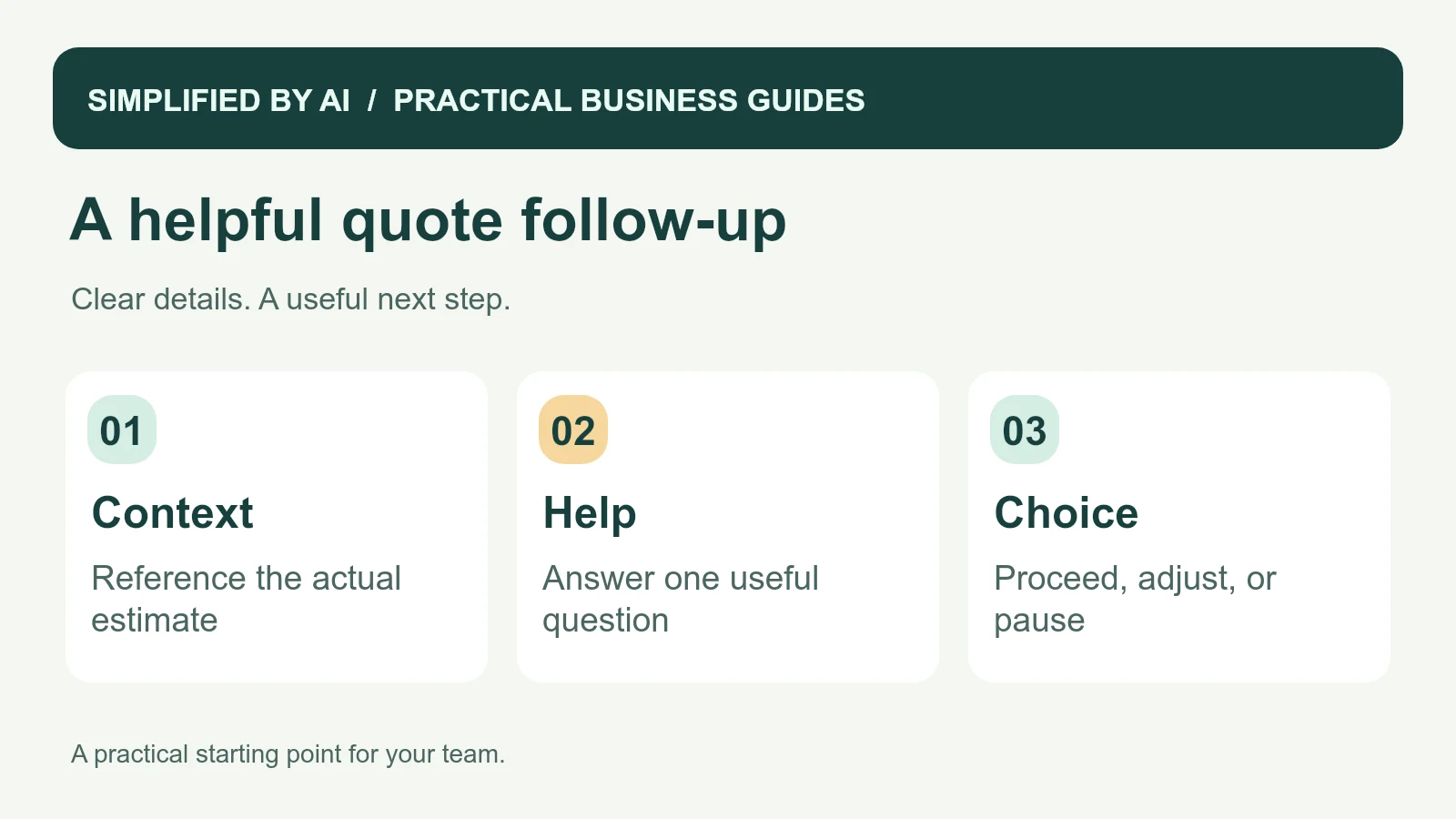
A follow-up earns its place when it makes the customer's decision easier. Check delivery, clarify an important item, confirm the desired timing, or explain an agreed revision. If all you can say is “just following up,” look at the original request and find the question the customer may still need answered.
- Reference the correct estimate number and date.
- Use the service or project name the customer recognizes.
- Ask one question that can be answered in a short reply.
- Offer a useful next step, such as a brief call.
- Check availability before suggesting a start date.
- Let the customer pause or end the conversation.
Read the subject and first sentence together. “A question about your estimate” is less useful than “Does estimate HOC-204 include the glass?” when that is the actual decision holding things up. Keep the subject accurate rather than trying to manufacture urgency.
Use a schedule that fits your sales cycle
For a typical non-urgent service estimate, you might check delivery after two or three business days, offer specific help about a week later, and review the opportunity before a final message. Treat that as an example schedule, not a rule. A customer who asked you to call next month should not enter a next-week sequence.
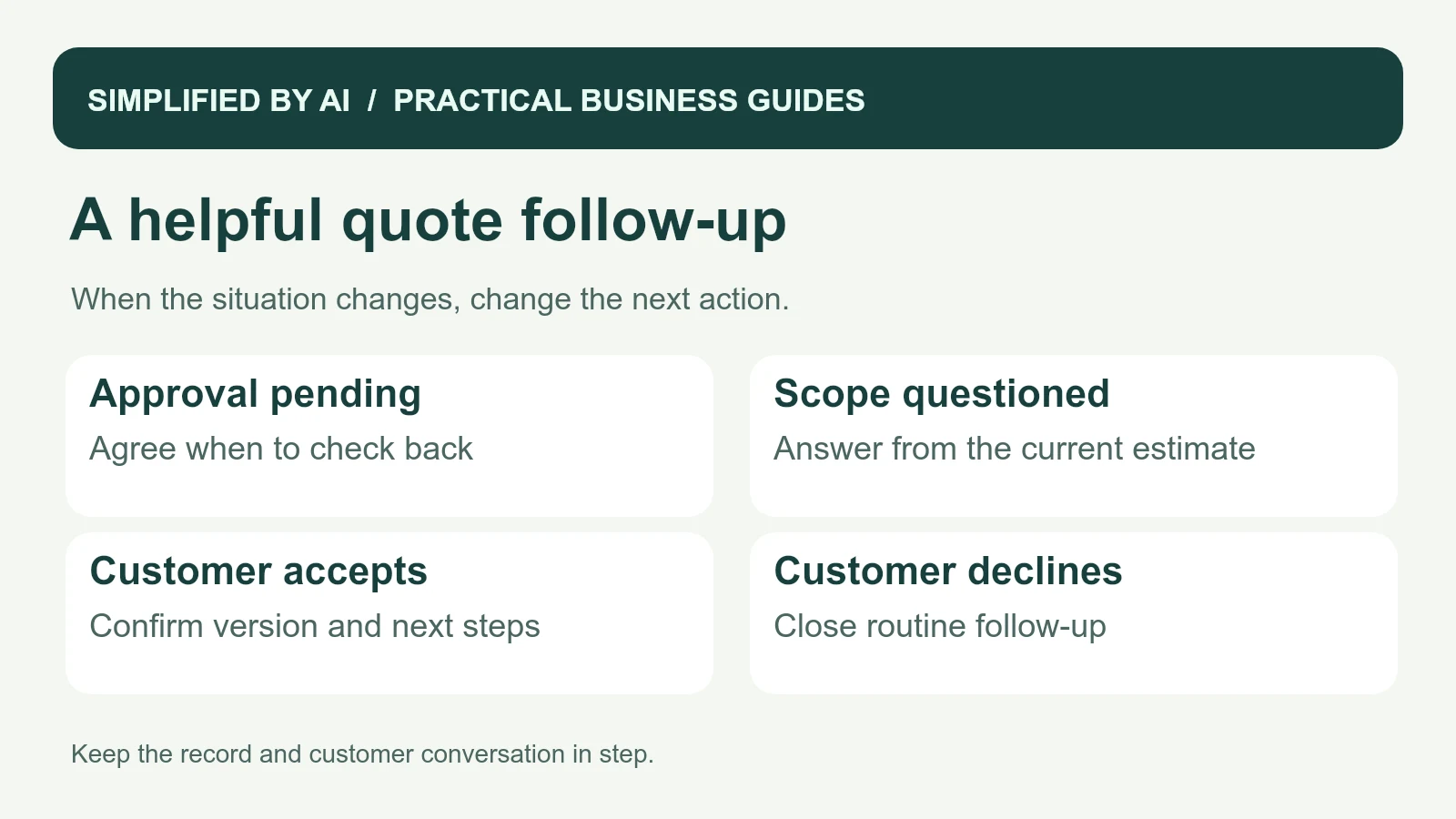
Record the next action when you send the estimate. After any reply, update the plan. A request for clarification should go to the person who can answer it; an acceptance should move into your client onboarding process. A decline or request to stop should end routine follow-up.
A filled-out follow-up that answers a real question
In this fictional example, Harbor Office Care sent estimate HOC-204 for twice-weekly cleaning. Morgan asked whether meeting-room glass was included. The coordinator checks the actual estimate before answering.
Example: clarify what the estimate includes
Subject: Meeting-room glass in estimate HOC-204

Hi Morgan,

Following up on your question about the glass: estimate HOC-204 includes the interior meeting-room glass partitions at each twice-weekly cleaning visit. Exterior windows are not included in this version.

Does that cover the area you had in mind, or would you like us to price the exterior windows separately?

Thanks,
Casey
Harbor Office Care
Customer reply: “The inside glass is what we meant. I need my manager to approve it at Monday's meeting. Could you check back Tuesday?” The coordinator records “Waiting for manager approval; check back Tuesday, October 20,” assigns the task to Casey, and pauses other reminders. The scope is understood, but the work has not been accepted.
If estimate details keep getting lost, our proposal and estimate preparation guide can help organize them before follow-up begins.
Match the next step to the reply
- They need approval: agree a realistic check-in date and wait until then.
- The price is too high: ask whether they want to discuss a smaller scope. Send a revised written estimate for any agreed change.
- They say “go ahead”: check which version they mean and complete your normal acceptance and scheduling steps.
- The project is paused: record when, or whether, they would like another contact.
- They decline or ask you to stop: close routine follow-up and record the preference.
Keep estimate status visible to the team
- Save the estimate number, version, customer, and date sent.
- Assign one person to own the conversation.
- Record the customer's preferred timing and reply channel.
- Set the next useful action and its date.
- Check for a reply or decision before contacting them again.
- Move accepted work into scheduling and pause closed opportunities.
A simple list may be enough at first. Add automation when repeated checking is taking time or when several employees share the work. Our lead follow-up guide explains how to connect reminders with the actual status of an inquiry.
Support trust through accurate, respectful messages
Use genuine validity dates and availability information. A customer should not feel rushed by a deadline invented for the message. Refer to another estimate only when you have actually been given it, and keep comparison advice factual.
The FTC's commercial email guidance explains that requirements depend on a message's primary purpose and can apply to business-to-business email. Have your business's usual identity, address, and preference-handling requirements checked for your specific use. These sample messages are business guidance, not legal advice.
For privacy and security, send the estimate only to the appropriate contact. The FTC recommends limiting access to personal information. Avoid copying unrelated people into a thread or including private site details that are not needed for the decision.
Keep a short record beside the estimate
Staff-only quote follow-up record
Customer and estimate reference:
Current estimate version:
Date sent:
Customer's main question or priority:
Status: Sent / Waiting for customer / Waiting for approval / Accepted / Paused / Declined
Last response:
Next agreed action and date:
Assigned to:
Routine reminders: Active / Paused / Closed
For the first few estimates, check whether another employee can tell what to do next from this record. Count corrected attachments, duplicate follow-ups, and missed agreed dates. Those are useful signs of where the process needs attention.
If estimates are scattered across inboxes and spreadsheets, our customer communication support can help bring the conversation and next action together. Start with a clear process your team likes using, then make the repetitive parts easier.
Frequently asked questions
How do I write a friendly quote follow-up email?
Name the estimate, give a short reason for writing, and ask one easy question. Offer help with scope or timing and let the customer tell you if the project is paused.
How many times should I follow up on a quote?
Choose a reasonable limit for your sales cycle and the customer's preference. The suggested schedule uses three contacts, with a personal review before the last one. Stop the sequence when someone replies or declines.
Should I offer a discount to get a reply?
A discount is a commercial decision, not a default follow-up step. First ask whether scope, timing, or an unanswered question is holding the customer back. Any revised price should receive the usual approval.
Can a quote follow-up email be automated?
Yes, if the estimate status is accurate and the sequence stops for replies, decisions, or requests to stop. Have a team member review messages about changed scope, availability, or pricing.
Keep good opportunities from getting lost
If estimates are hard to track once they leave your inbox, we can help organize quote status, useful reminders, and the next action for your team.