Customer Communication
Overdue Invoice Reminder Email: 5 Friendly Templates
Spend less time chasing invoices with clear, courteous reminders your customers can act on.
Short answer: A useful overdue invoice reminder email identifies the invoice, states the amount still due, and gives the customer an easy way to pay or ask a question. Keep it warm, factual, and brief. The five templates below help you follow up consistently while leaving room for a genuine conversation.
For a small business, the awkward part is often deciding how to ask without damaging a good relationship. Choose the message that fits the account: first reminder, no response, partial payment, missed agreed date, or a personal conversation. These are alternatives for different situations; you do not need to send all five.
Five overdue invoice reminder email templates
Replace every bracketed field before sending. Check the outstanding balance in your billing records, including recent and partial payments. The timings are starting points to adapt to your agreement and customer relationship.
1. A friendly first reminder
Subject: A quick reminder about invoice [number]

Hi [first name],

I hope you are doing well. I am following up on invoice [number] for [service], which was due on [date]. The outstanding balance is [amount].

You can view the invoice and pay here: [payment link].

If payment is already on its way, thank you. Please let me know so I can check our records. I am also happy to help if you have a question about the invoice.

Thanks,
[your name]
[business name]
[contact details]
2. A second reminder with a clear question
Subject: Can I help with invoice [number]?

Hi [first name],

I wanted to check that you received invoice [number] for [service]. Our records currently show [amount] outstanding, with an original due date of [date].

Would you let me know whether you need another copy, have a question, or can share the expected payment date?

Invoice and payment details: [payment link].

Thank you,
[your name]
[business name]
[contact details]
3. A reminder after a partial payment
Subject: Remaining balance on invoice [number]

Hi [first name],

Thank you for your payment of [amount received]. We have applied it to invoice [number].

The remaining balance is [amount still due], originally due on [date]. You can see the updated invoice here: [invoice link].

Please reply if your records show a different balance or if you would like to discuss the next step.

Thanks again,
[your name]
[business name]
[contact details]
4. A check-in after an agreed payment date
Subject: Checking in on invoice [number]

Hi [first name],

When we last spoke, we expected payment for invoice [number] by [agreed date]. I have checked our records and the outstanding balance is currently [amount].

Could you confirm whether payment has been sent, or let me know an updated date?

Here is the invoice for convenience: [invoice link].

Thank you for keeping me updated,
[your name]
[business name]
[contact details]
5. A personal check-in before deciding the next step
Subject: Let us find the next step for invoice [number]

Hi [first name],

I have been trying to reach you about invoice [number] for [service]. The balance in our records is [amount], with an original due date of [date].

Could we arrange a brief call or confirm the next step by [reply date]? If there is a question about the work or invoice, I would appreciate the chance to understand it.

You can reach me at [contact details].

Thank you,
[your name]
[business name]
When to follow up, and when to pause
Use the due date agreed with the customer. The schedule below is an illustrative starting point for ordinary service invoices, rather than a collection rule. Check your payment record immediately before every message.
| Account situation | Useful next action |
|---|---|
| First business day after the due date; no payment or reply | Send template 1 with the current invoice and payment link. |
| About a week later; still no reply | Check the billing contact, then use template 2 to ask whether something is missing. |
| Part of the invoice is paid | Reconcile the payment, update the balance, and use template 3. |
| An agreed payment date has passed | Check for a pending payment before using template 4. |
| Repeated silence or an unresolved concern | Review the account personally. Template 5 offers a conversation before you decide another step. |
| A payment, question, dispute, or agreed pause | Stop the routine sequence and deal with that event first. |
If payments take time to appear in your records, allow for your provider's reconciliation process. A transfer confirmation is a reason to investigate, rather than send another automatic demand. Our shared inbox guide can help make billing replies visible to the person handling the account.
A filled-out invoice reminder example
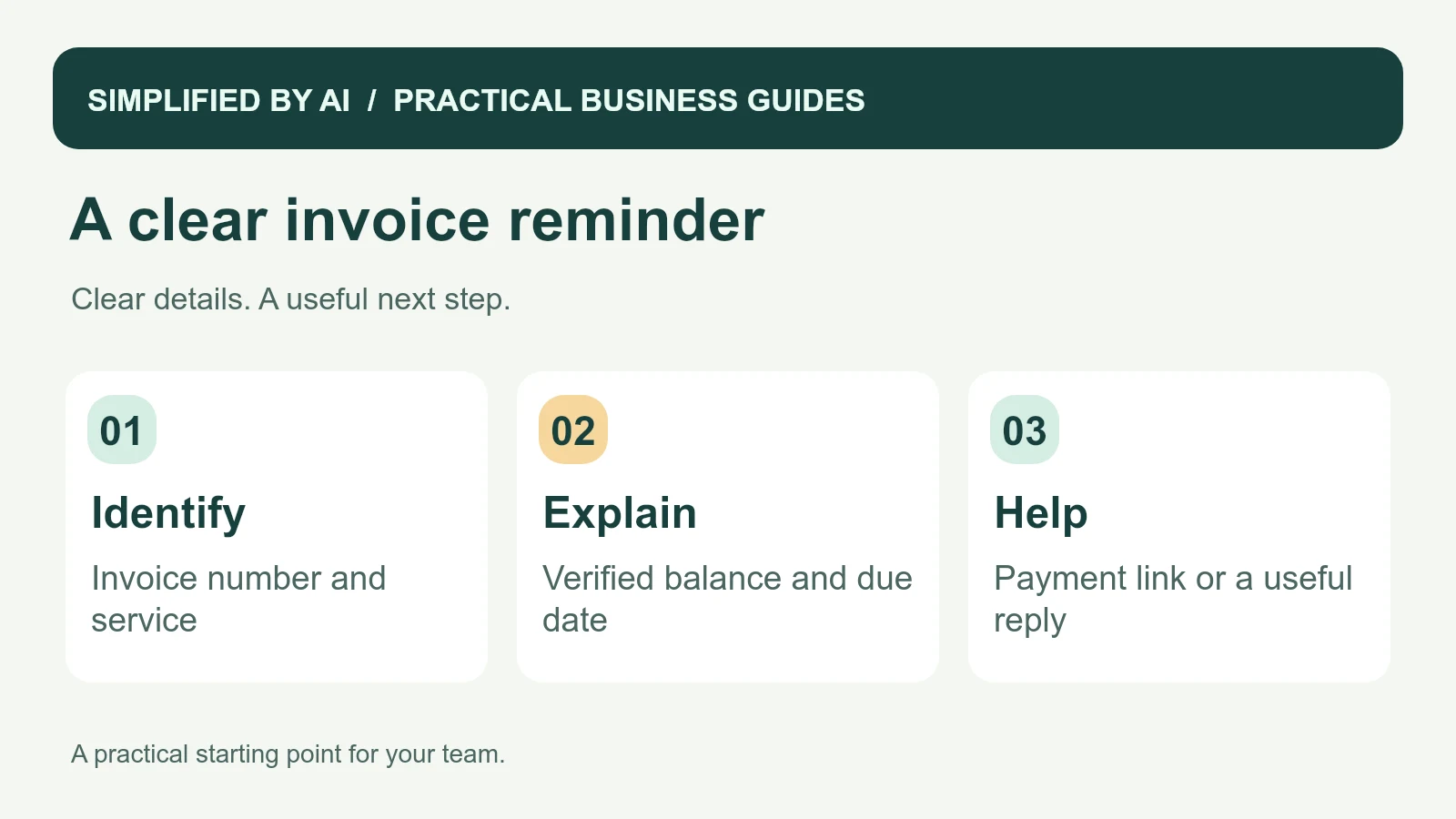
In this illustrative example, Maple Lane Services completed a maintenance visit for $480. The customer paid $300, leaving $180 outstanding. The invoice was due October 6. Before following up, the office checks that the payment has cleared and the invoice really shows the reduced balance.
Example: a remaining balance of $180
Subject: Remaining balance on invoice ML-1428

Hi Morgan,

Thank you for your $300 payment for the maintenance visit. We have applied it to invoice ML-1428.

The remaining balance is USD 180, originally due October 6. I have attached the updated invoice with the payment details so you can check the balance and arrange payment.

If your records show something different, please reply and I will take a look.

Thanks,
Jamie
Maple Lane Services
The message works because it acknowledges what the customer has already done. It does not ask for the full $480 again or imply that an email proves a payment failed. If Morgan replies with a transfer confirmation, Jamie checks the accounting record and closes the follow-up once the payment is recorded.
Make paying or replying straightforward
Use a familiar sender name and an accurate subject. Keep the main request near the beginning. Link to your normal invoice or payment page, or attach the invoice through your usual secure process. Customers should not have to search an old thread to understand what you are asking them to do.
Give customers a reply address someone monitors, and make sure the team knows who will answer a billing question.
- Use the amount still due, with its currency.
- Include the original due date rather than an ambiguous “recently.”
- Check that the invoice number matches the attachment.
- Keep service descriptions short and recognizable.
- Use payment links supplied by your normal billing provider.
Keep accurate records and protect customer details
Keep invoice copies, payment records, and follow-up notes together. The IRS explains that invoices and receipts support business records. Your reminders are easier to manage when staff can see the same current information.
For privacy and security, avoid asking customers to email card numbers or account credentials. The FTC recommends collecting only needed information and restricting access. Let your established payment process handle sensitive payment details. This guide is practical business information, not legal advice; get qualified advice before changing fees, collection steps, or payment terms.
Reduce the checking and chasing around reminders
Once the manual process works, a connected reminder system can prepare the next message from verified invoice data and put replies in one follow-up queue. Start with draft reminders that your team reviews. Test a paid invoice, a partial payment, a disputed amount, and a customer who replies before the next scheduled contact.
If these checks are taking up too much staff time, our customer communication support can help organize the process. Connect it with a job completion form so the office has clear service notes before preparing the invoice.
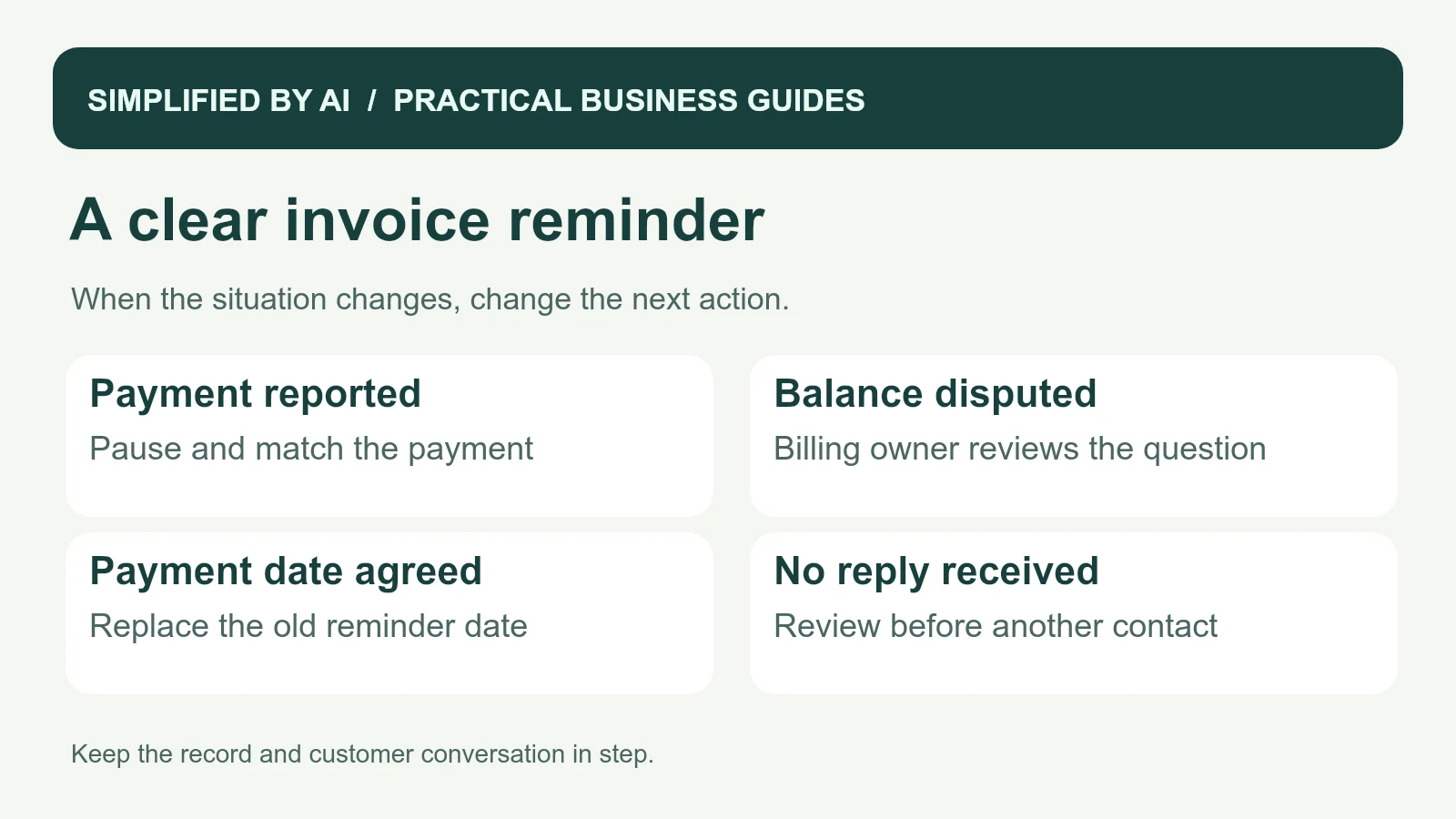
If the owner reviews open invoices each week, include the next action and assigned person in the recurring owner snapshot. Keep the invoice record as the source for the balance so a summary does not become a second, conflicting ledger.
What to do when the customer replies
“We already paid.”
Thank them, pause reminders, and check the invoice number, amount, and payment date against your records. Ask for a transaction reference if you need it, rather than full banking details. Confirm when the payment is matched.
“This amount looks wrong.”
Ask which item needs checking and send it to the billing owner. Give a realistic update date. Resume payment follow-up only after the question is resolved and the balance is clear to both sides.
“Can we pay next Friday?”
Have the person authorized to agree payment arrangements respond. If agreed, record the amount and date, confirm them to the customer, and replace the old reminder date. Avoid leaving a second sequence running.
A simple follow-up record
Keep this staff note beside the invoice, with one owner for each open action.
Staff-only invoice follow-up record
Invoice reference:
Balance and currency checked:
Checked at:
Last contact and customer response:
Reminder status: Ready / Paused / Closed
Next agreed action:
Owner:
Next review date:
Try the process on a few open invoices first. A useful check is whether any reminder went out after a payment or a reply. Fix that mismatch before expanding the sequence.
Frequently asked questions
What should an overdue invoice reminder email include?
Include the invoice number, a brief service description, the original due date, the verified outstanding balance, and a payment or reply option. Sign with the name of someone the customer can reach.
How often should a small business send invoice reminders?
Use a modest schedule suited to the agreed payment terms. The example here uses the first business day overdue, about a week later, and a personal review after that. Pause whenever the customer replies.
What if the customer says the invoice is wrong?
Acknowledge the question, pause the reminder sequence, and ask the person responsible for billing to review the records. Agree on the next update rather than repeating the payment request.
Can invoice reminders be automated?
Yes, when they use current invoice records and stop after payment, a dispute, or a reply requiring attention. Begin by reviewing every reminder and test partial payments before enabling automatic sending.
Make payment follow-up easier to manage
If checking balances and chasing replies is taking over your week, we can help connect your invoice records, reminders, and team follow-up.